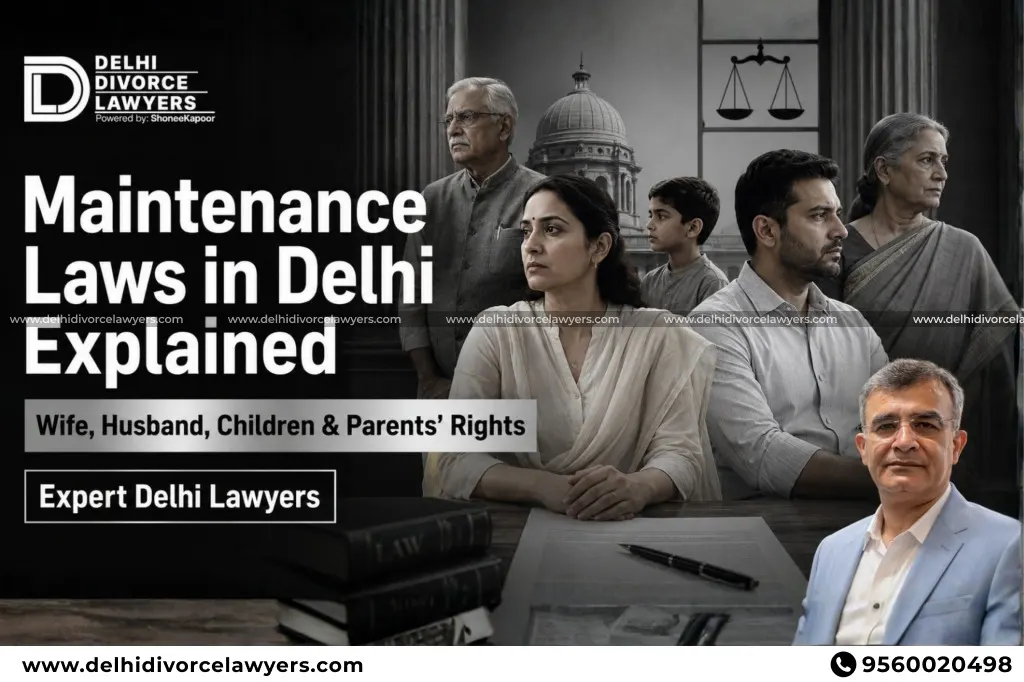
Complete 2026 Guide to Maintenance in Delhi: Wife, Husband, Children & Parents’ Rights
NEW DELHI: Maintenance is one of the most misunderstood and heavily contested issues in matrimonial litigation.
“Wife always gets one-third of the husband’s salary.”
“Husband can never claim maintenance.”
“An earning wife cannot get maintenance.”
“Once maintenance is fixed, it can never be reduced.”
All four statements are legally incorrect.
There is no single formula that decides every maintenance case. In Delhi, the court examines the applicable law, income and assets of both parties, reasonable needs, liabilities, dependants, standard of living and the financial evidence placed on record.
This becomes especially important for husbands facing maintenance proceedings. A maintenance order cannot be based merely on an alleged salary figure, inflated income claims or an assumed percentage of earnings. The Delhi High Court reiterated on 30 July 2026 that there is “no inflexible formula for determining maintenance.”
At the same time, maintenance law is not limited to wives. Depending on the statute and facts, husbands, children and parents may also have enforceable maintenance rights.
The first major change every litigant should understand is this: the old Section 125 CrPC framework has now been replaced, for proceedings governed by the Bharatiya Nagarik Suraksha Sanhita, 2023, by Section 144 BNSS. The BNSS came into force on 1 July 2024. Older judgments still refer to Section 125 CrPC because those cases arose under the previous law.
SECTION 125 CRPC HAS CHANGED: KNOW SECTION 144 BNSS
The present summary-maintenance provision is Section 144 BNSS – Order for Maintenance of Wives, Children and Parents.
In simple terms, the legal position is:
| Claimant | Important legal route | Basic position |
| Wife | Section 144 BNSS, Sections 24/25 HMA, Section 20 DV Act, where applicable | Maintenance is not automatic; entitlement depends on the statute, facts and evidence |
| Husband | Sections 24 and 25 Hindu Marriage Act | The HMA permits either spouse to seek maintenance, subject to statutory conditions |
| Children | Section 144 BNSS and other applicable matrimonial/personal laws | A child’s maintenance right is distinct from the spouse’s claim |
| Parents | Section 144 BNSS and the Maintenance and Welfare of Parents and Senior Citizens Act, 2007 | Parents unable to maintain themselves may have an independent statutory remedy |
The real question in a maintenance case, therefore, is not simply “Who is the husband and who is the wife?” It is who is legally entitled, under which provision, on what evidence and for what amount.
CAN A WIFE CLAIM MAINTENANCE IN DELHI?
Yes. But the legally correct sentence is not “a wife is entitled to maintenance.”
It is: a wife may be entitled to maintenance if the statutory requirements applicable to her proceeding are satisfied.
Under Section 144 BNSS, a person having sufficient means who neglects or refuses to maintain his wife who is unable to maintain herself may be directed to pay maintenance. For this provision, “wife” also includes a divorced woman who has not remarried.
The same section also contains express disqualifications. A wife is not entitled under Section 144 if she is living in adultery, refuses to live with her husband without sufficient reason, or the spouses are living separately by mutual consent. Each defence has to be established on evidence; merely making an allegation does not prove it.
The Protection of Women from Domestic Violence Act, 2005 separately permits monetary relief, including maintenance, for an aggrieved woman and her children where the requirements of that Act are established. Section 20 requires the relief to be adequate, fair and reasonable and consistent with the standard of living to which the aggrieved person was accustomed.
AN EARNING OR EDUCATED WIFE IS NOT AUTOMATICALLY DISENTITLED TO MAINTENANCE
This point is routinely oversimplified by both sides.
In the case of Dhirendra Kumar v. Swati Saista, decided by the Delhi High Court, the wife was a B.Tech graduate and had previously worked. The Court held that qualifications and employability can be considered and that a professionally qualified spouse may be required to make bona fide efforts towards suitable employment. But it also reiterated the distinction between capacity to earn and actual earnings.
Therefore, “she is educated” is not by itself a complete defence. Equally, actual employment, income, investments and financial resources cannot simply be ignored.
That is where evidence becomes more important than slogans.
CAN A HUSBAND CLAIM MAINTENANCE FROM HIS WIFE?
Yes, under the Hindu Marriage Act in an appropriate case.
Section 24 HMA is deliberately gender-neutral. Where either the wife or the husband has no independent income sufficient for support and the necessary expenses of the proceeding, the court may direct the respondent to pay litigation expenses and monthly maintenance during the proceeding.
Similarly, Section 25 HMA, dealing with permanent alimony and maintenance, allows the court to grant relief to either spouse while considering income, property, conduct and other circumstances recognised by the provision.
This is a fact many men are never told.
However, it must not be exaggerated. Section 144 BNSS does not create a corresponding spousal-maintenance claim by a husband against his wife. A husband’s remedy depends on the applicable matrimonial statute. Sections 24 and 25 HMA therefore cannot simply be treated as universal provisions for every marriage.
Men’s rights begin with knowing the law accurately, not converting one favourable provision into another legal myth.
HOW MUCH MAINTENANCE CAN A DELHI COURT AWARD?
There is no statutory 25%, one-third or 50% formula applicable to every maintenance case.
The Supreme Court’s landmark decision in Rajnesh v. Neha (2021) 2 SCC 324 laid down a structured framework for maintenance proceedings. The Delhi High Court applied those principles again in July 2026.
Relevant considerations include the parties’ status, reasonable needs, independent income, matrimonial standard of living, the respondent’s actual income and liabilities, and responsibility towards dependent children and other legally dependent family members.
The Delhi High Court specifically said that salary slips, Form 16, income-tax information, bank statements, employer-related credits, statutory deductions, reasonable personal liabilities and expenditure on dependent children must be examined together. An interim assessment may involve approximation, but it cannot be arbitrary.
A proper determination must be based on financial material.
RAJNESH v. NEHA: BOTH SIDES MUST DISCLOSE THEIR FINANCES
The Supreme Court directed that Affidavits of Disclosure of Assets and Liabilities be filed in maintenance proceedings across the country. The purpose is straightforward: the court cannot fairly determine maintenance when income, property, expenditure or liabilities are concealed.
The judgment itself recognised problems on both sides: exaggeration of needs by claimants and concealment of actual income by respondents.
For a husband defending an inflated maintenance claim, therefore, hiding income is usually the worst strategy.
The better strategy is to disclose accurately and document everything: genuine net income, tax deductions, existing maintenance, dependent children, dependent parents, medical expenditure, rent, loans that are genuinely relevant, loss of employment and other material changes in financial circumstances.
CAN A WIFE RECEIVE MAINTENANCE FROM MULTIPLE CASES?
Different legal proceedings may be maintainable, but that does not mean unrestricted double recovery.
In the case of Rajnesh v. Neha(2021) 2 SCC 324 , the Supreme Court directed applicants to disclose previous maintenance proceedings and orders. When maintenance has already been awarded in an earlier proceeding, the subsequent court must take that amount into consideration and consider adjustment or set-off.
This is one of the most important safeguards a husband facing simultaneous HMA, DV Act and maintenance proceedings should know.
CAN MAINTENANCE BE REDUCED IF THE HUSBAND LOSES HIS JOB?
A genuine and substantial change in financial circumstances can justify reconsideration. But unemployment does not automatically extinguish liability.
The 2026 Dhirendra Kumar case is particularly important. The original interim maintenance was ₹1 lakh per month. Following cessation of regular salary and termination of the husband’s employment, a later proceeding under Section 25(2) of the DV Act reduced maintenance to ₹15,000 per month from 20 May 2022; that reduction was subsequently affirmed. The Delhi High Court explained that a later change in employment, income or liabilities may require prospective adjustment, while not necessarily making the original order illegal when passed.
That is a far more useful principle than telling a husband either “you must pay forever regardless of circumstances” or “just leave your job and maintenance stops.” Both propositions are legally dangerous.
CHILD MAINTENANCE IS A SEPARATE RIGHT
A dispute between husband and wife does not extinguish or dilute a child’s independent right to maintenance.
Under Section 144 BNSS, maintenance may be claimed for a minor child who is unable to maintain himself or herself. The provision also extends, in specified circumstances, to a major child who is unable to maintain himself or herself because of a physical or mental abnormality or injury.
Child’s claim is independent of the wife’s claim
An important Delhi example is Neha Arora v. Vishal Arora, decided by the Delhi High Court on 30 April 2025.
On the facts of that case, the Court upheld the denial of interim maintenance to the wife after finding that she had withdrawn from the company of her husband without sufficient justification. However, the ₹3,500 per month maintenance awarded to the minor daughter was left undisturbed.
The judgment highlights an important legal distinction:
A husband may successfully contest the wife’s personal claim for maintenance, but that defence does not automatically defeat the child’s independent entitlement.
Courts therefore examine the wife’s claim and the child’s claim separately, based on the applicable law, the child’s needs, the financial capacity of the parents and the evidence placed before the court
CAN PARENTS CLAIM MAINTENANCE IN DELHI?
Yes.
Section 144 BNSS expressly includes father and mother who are unable to maintain themselves.
Parents and senior citizens may also have remedies under the Maintenance and Welfare of Parents and Senior Citizens Act, 2007.
Delhi has established 11 Maintenance Tribunals and Appellate Tribunals across its districts. The Delhi Government states that Maintenance Tribunals are headed by the ADM as presiding officer/chairperson, while the Appellate Tribunals are headed by the Deputy Commissioner (Revenue).
For husbands whose genuinely dependent parents are financially supported by them, those responsibilities are also relevant when presenting a truthful picture of disposable income and liabilities before a matrimonial court. The Supreme Court’s maintenance framework expressly recognises legally dependent family members as a relevant consideration.
WHAT THE COURTS ACTUALLY SAID
Indian courts have repeatedly made it clear that maintenance cannot be decided through rigid formulas or assumptions.
Supreme Court: Maintenance must be reasonable
In Rajnesh v. Neha, the Supreme Court observed:
“The maintenance amount awarded must be reasonable and realistic.”
The emphasis is therefore on a fair assessment of the parties’ actual income, needs, liabilities and overall financial circumstances.
Delhi High Court: There is no fixed formula
On 30 July 2026, the Delhi High Court reiterated:
“There is no inflexible formula for determining maintenance.”
This directly rejects the popular belief that maintenance must automatically be fixed at one-third, 25% or any other predetermined percentage of the husband’s income.
Wife’s claim and child’s claim are separate
In Neha Arora v. Vishal Arora, the Delhi High Court upheld the denial of interim maintenance to the wife on the facts of that case, while allowing the maintenance awarded to the minor daughter to continue.
The principle is important: a wife’s personal entitlement to maintenance and a child’s right to maintenance are legally distinct issues and must be examined separately.
Taken together, these judgments reinforce one basic rule: Maintenance must be determined on evidence, statutory entitlement, and individual facts, not on social-media formulas or gender-based assumptions.
CONCLUSION
Maintenance law is meant to provide financial support, not create financial punishment.
Delhi courts do not decide maintenance through a fixed percentage, a gender-based presumption or one isolated salary figure. The court must examine the actual income, assets, reasonable needs, liabilities, dependants, standard of living and financial evidence of the parties before arriving at a fair amount.
A spouse who is genuinely unable to maintain himself or herself deserves protection under the applicable law. Children have an independent right to maintenance, irrespective of disputes between their parents, while dependent parents also enjoy statutory protection.
At the same time, a husband should not be saddled with an unrealistic maintenance liability merely because a higher income has been alleged against him. Concealed income, exaggerated expenses, overlapping maintenance proceedings and incorrect assumptions about earning capacity must be tested against documentary evidence.
For husbands facing maintenance proceedings in Delhi, therefore, the strongest legal strategy is not to merely argue that the demand is excessive. It is to place the complete financial picture before the court through income records, bank statements, tax documents, genuine liabilities, dependent-family expenses and disclosures of parallel maintenance proceedings.
The principles flowing from Section 144 BNSS, Sections 24 and 25 of the Hindu Marriage Act, the DV Act, Rajnesh v. Neha and subsequent Delhi High Court judgments ultimately point towards one fundamental rule:
Maintenance must be based on need, means and evidence, not assumptions.
The law should protect genuine dependency. It should neither deny legitimate support nor convert maintenance into punishment by presumption.
FAQs
- Is a wife automatically entitled to maintenance in Delhi?
No. Her entitlement depends on the applicable statute, financial circumstances and statutory conditions or disqualifications. - Can a husband claim maintenance from his wife?
Yes. Sections 24 and 25 of the HMA are gender-neutral and permit an eligible husband to seek relief in proceedings governed by the Hindu Marriage Act. - Is maintenance fixed at 25% or one-third of the husband’s salary?
No. There is no universal fixed percentage. Courts consider income, needs, liabilities, dependants and other relevant circumstances. - Can a child get maintenance even if the wife is denied maintenance?
Yes. A child’s claim is distinct. Neha Arora v. Vishal Arora is a Delhi High Court example where the wife’s claim failed, but the daughter’s maintenance continued. - Can parents claim maintenance from their children in Delhi?
Yes. Section 144 BNSS protects eligible parents, and the Senior Citizens Act provides a separate statutory mechanism through Maintenance Tribunals in Delhi.