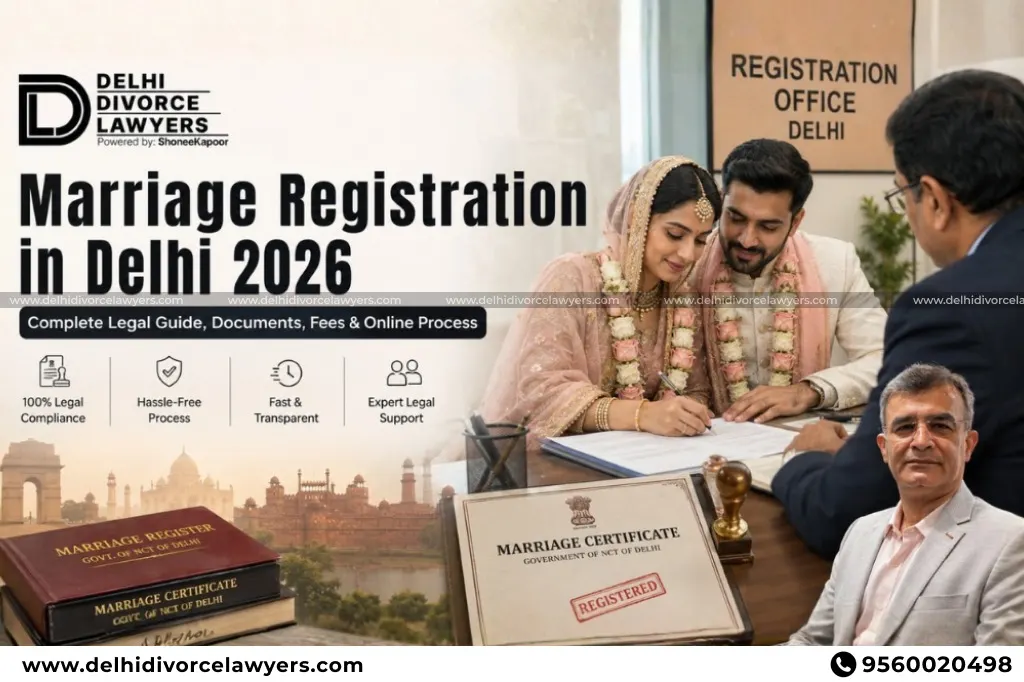
A practical legal guide to marriage registration in Delhi, including required documents, government fees, online application steps and certificate procedures.
NEW DELHI: A wedding ceremony may establish the marital relationship, but a government-issued marriage certificate creates a permanent documentary record of it.
Marriage registration becomes important when spouses apply for passports, visas, joint bank accounts, insurance benefits, succession certificates, property documents or matrimonial remedies. It can also become critical when the date, place or even existence of the marriage is disputed during divorce, maintenance, inheritance or criminal proceedings.
In the case of Seema v. Ashwani Kumar, (2006) 2 SCC 578, the Supreme Court directed that marriages of Indian citizens belonging to various religions should be made compulsorily registrable in the State or Union Territory where they are solemnised. Delhi subsequently introduced the Delhi (Compulsory Registration of Marriage) Order, 2014 for marriages solemnised within the National Capital Territory (NCT).
From a legal-risk perspective, the message is simple: do not wait for a matrimonial dispute before securing documentary proof of your marriage. Photographs, invitation cards and private temple certificates may support a claim, but they are not substitutes for a properly issued government marriage certificate.
MARRIAGE REGISTRATION AND COURT MARRIAGE ARE NOT THE SAME
These two procedures are regularly confused.
Marriage Registration: Marriage registration records a marriage that has already been solemnised. The couple first marries according to the applicable religion, custom or personal law and subsequently approaches the Marriage Officer for registration.
For example, a Hindu couple who has already married through customary ceremonies may register the marriage under Section 8 of the Hindu Marriage Act, 1955.
Court Marriage: A “court marriage” generally means solemnisation before a Marriage Officer under the Special Marriage Act, 1954. It does not ordinarily take place before a judge or inside a courtroom.
The parties submit a notice of intended marriage. At least one party must have resided within the Marriage Officer’s district for at least 30 days before giving the notice. The notice is published, a 30-day objection period follows, and the marriage is then solemnised before the Marriage Officer and three witnesses.
Therefore:
- Already married through a ceremony: Apply for marriage registration.
- Not yet married and seeking a civil marriage: Apply for solemnisation under the Special Marriage Act.
WHICH LAW APPLIES TO MARRIAGE REGISTRATION IN DELHI?
The correct legal route depends on the nature of the marriage.
Hindu Marriage Act, 1955
This route generally applies where both spouses are Hindus, Buddhists, Jains or Sikhs and the marriage has already been solemnised according to applicable rites and ceremonies.
Section 8 provides for registration of Hindu marriages. However, registration does not replace the marriage ceremony required under Section 7.
Special Marriage Act, 1954
The Special Marriage Act can be used for:
- Solemnisation of a civil marriage before the Marriage Officer; or
- Registration of an existing marriage celebrated in another form under Sections 15 to 18.
The Act is not restricted only to interfaith couples. Two persons belonging to the same religion may also marry under it.
Delhi (Compulsory Registration of Marriage) Order, 2014
This route applies to marriages solemnised within Delhi where at least one spouse is an Indian citizen. The application is ordinarily required within 60 days, excluding the date on which the final marriage ceremony was solemnised. Both spouses and two witnesses must appear before the Marriage Officer.
The Order also states that registration does not, by itself, decide whether the underlying marriage was legally valid. Validity continues to depend on the applicable personal law, statute, custom or usage.
BASIC ELIGIBILITY FOR MARRIAGE REGISTRATION IN DELHI
For registration under the Delhi (Compulsory Registration of Marriage) Order, 2014 or the Hindu Marriage Act, 1955, the principal requirements include:
- The groom must have completed 21 years of age.
- The bride must have completed 18 years of age.
- The marriage must have been solemnised within Delhi for registration under the Delhi Order.
- At least one spouse must satisfy the applicable citizenship or Delhi jurisdiction requirement.
- Both spouses must appear before the Marriage Officer.
- Neither spouse should have another legally subsisting spouse.
- The parties should not fall within prohibited degrees of relationship unless a legally recognised custom permits the marriage.
- Two Delhi-resident witnesses are ordinarily required under the Delhi compulsory-registration and Hindu marriage processes.
For registration of an already-celebrated marriage under Chapter III of the Special Marriage Act, 1954, both parties must have completed 21 years of age at the time of registration. They must have lived together as spouses after a marriage ceremony, neither may have another living spouse, and both must have resided within the Marriage Officer’s district for at least 30 days immediately before applying. Three witnesses are required.
This age distinction is frequently overlooked:
- Solemnisation under the Special Marriage Act: the man must be 21 years old and the woman 18 years old.
- Registration under Sections 15–18 of an already-celebrated marriage: both parties must be 21 years old.
WHERE SHOULD THE APPLICATION BE FILED?
The application is generally filed before the SDM or Marriage Officer having territorial jurisdiction over the place where either spouse resides.
Where the marriage was solemnised in Delhi but neither spouse presently resides in Delhi, official Revenue Department guidance permits an application before the authority within whose jurisdiction the marriage was solemnised.
Applicants should use the “Locate Your Sub-Division” facility on the Delhi e-District portal before selecting an SDM office. Choosing the wrong subdivision may result in objections, resubmission or cancellation of the appointment.
DOCUMENTS REQUIRED FOR MARRIAGE REGISTRATION IN DELHI
The exact checklist generated by the portal should always be followed. The commonly required documents include:
Documents of Both Spouses
- Completed application signed by both spouses
- Aadhaar, passport, voter ID, PAN card, driving licence or another accepted identity document
- Date-of-birth proof
- Present Delhi residence proof
- Permanent residence proof, wherever requested
- Passport-size colour photographs
- Wedding or ceremonial photographs
- Marriage invitation card, if available
- Separate prescribed affidavits from both spouses
- Proof showing the date and place of marriage
- Certificate from the priest, pandit, maulvi, granthi or religious institution where applicable
Aadhaar is not the only accepted identity document under the current Delhi Revenue guidance. Alternatives include a voter ID card, driving licence, passport or PAN card.
Documents of Witnesses
Each witness may be required to provide:
- Identity proof
- Permanent Delhi residence proof
- Passport-size photograph, where requested
- Personal presence on the appointment date
Two witnesses are generally required under the Hindu Marriage Act, 1955 or the Delhi compulsory-registration route. Three witnesses are required under the Special Marriage Act, 1954.
Additional Documents in Special Cases
- Certified divorce decree if either spouse was previously divorced
- Death certificate of the former spouse if either party is a widow or widower
- Embassy certificate concerning present marital status and nationality for a foreign national
- Conversion certificate where conversion is relied upon
- Passport and valid visa documents of a foreign spouse
- Any additional residence or marital-status declaration required by the Marriage Officer
The current District New Delhi checklist states that affidavits must be uploaded with the online application and that the originals may still have to be produced or submitted for verification.
GOVERNMENT FEES FOR MARRIAGE REGISTRATION IN DELHI
Applicants should be cautious because some older Delhi Revenue webpages continue to display legacy figures of ₹100 or ₹15. Later Delhi Gazette amendments available on the Revenue Department’s notification page prescribe the revised fees set out below.
Hindu Marriage Registration
- Solemnising or registering the marriage: ₹500
- Certified extract from the Marriage Register: ₹100 per copy
Special Marriage Act
- Notice of intended marriage for registration: ₹100
- Solemnising or registering the marriage: ₹500
- Certified copy of an entry: ₹100 per entry
Delhi (Compulsory Registration of Marriage) Order, 2014
- Basic registration fee: ₹500
- Additional Tatkal fee: ₹1,000, subject to the applicable procedure and availability of the service
The amount generated by the portal or specified in writing by the Marriage Officer should be checked before payment. Applicants should preserve the payment receipt and acknowledgement number.
WHAT HAPPENS IF THE MARRIAGE IS REGISTERED LATE?
Under the Delhi (Compulsory Registration of Marriage) Order, 2014, the application should ordinarily be submitted within 60 days of the final marriage ceremony.
The Marriage Officer may condone a limited additional delay upon payment of the prescribed additional amount. A further delay can attract the penalty specified under the Order. Registration may still be possible, but the applicant may have to explain the delay and comply with additional procedural requirements.
Delay does not automatically prove that the marriage was invalid. However, postponing registration creates unnecessary evidentiary complications.
ONLINE MARRIAGE REGISTRATION PROCESS IN DELHI
Delhi provides online facilities through the e-District Delhi portal. Citizens can apply for the service, track the application, verify a certificate and print or download an issued certificate.
Step 1: Create an e-District Account
Register using a valid mobile number and complete the verification process. The portal states that account activation must be completed within the specified verification period.
Step 2: Select the Marriage Registration Service
Log in and choose the Revenue Department’s marriage registration service.
Select the correct legal route:
- Hindu Marriage Act
- Special Marriage Act
- Delhi (Compulsory Registration of Marriage) Order, 2014
Choosing the wrong statute can result in an objection or rejection.
Step 3: Complete the Application
Enter the following details carefully:
- Full names of both spouses
- Dates of birth
- Marital status before marriage
- Citizenship and nationality
- Present and permanent addresses
- Date and precise place of marriage
- Details of witnesses
- Applicable religion or legal route
Names and dates should match the supporting documents exactly.
Step 4: Upload Documents
Upload readable, correctly oriented copies of all required documents, affidavits and photographs.
Blurred images, cropped documents, inconsistent names and unreadable addresses are common reasons for objections.
Step 5: Pay the Applicable Fee
Pay the amount displayed for the selected service and retain the receipt.
Step 6: Book or Receive the Appointment
After preliminary scrutiny, the portal or SDM office will communicate the appointment date.
An online application does not remove the requirement of personal appearance.
Step 7: Attend the SDM Office
Both spouses must appear with the required witnesses, original documents and the application acknowledgement.
The Marriage Officer may verify:
- Identity of the spouses
- Voluntary consent
- Date and place of marriage
- Marital status
- Residence and jurisdiction
- Identity and knowledge of witnesses
- Performance of the claimed marriage ceremony
Step 8: Download or Collect the Certificate
After approval, the certificate may be downloaded, printed or verified through the portal’s certificate services.
HOW LONG DOES MARRIAGE REGISTRATION TAKE IN DELHI?
For Hindu marriage registration, Delhi’s official webpages indicate a normal service benchmark of approximately 14 to 15 days, although the certificate may be issued on the scheduled appointment date after successful verification.
Under the Special Marriage Act, 1954, the mandatory public-notice period is 30 days. The Revenue Department states a normal response period of approximately 60 days for Special Marriage Act applications. Objections, document discrepancies or jurisdictional issues can extend the process.
A genuine Special Marriage Act procedure cannot ordinarily be completed immediately because the statutory notice period cannot simply be bypassed by a private agent.
DOES A MARRIAGE CERTIFICATE MAKE EVERY MARRIAGE VALID?
No. A marriage certificate is important evidence, but registration cannot create a valid Hindu marriage where no legally recognised marriage ceremony took place.
In the case of Dolly Rani v. Manish Kumar Chanchal, 2024 INSC 355, the Supreme Court questioned the parties directly. They accepted that no customs, rites or rituals had been performed and that “there was no ‘marriage’ solemnized by them.”
The Court explained that registration facilitates proof of a Hindu marriage, but where no marriage was solemnised according to Section 7, “the registration would not confer legitimacy to the marriage.”
This judgment establishes two separate principles:
- Failure to register does not, by itself, invalidate an otherwise valid Hindu marriage.
- Registration cannot validate a Hindu marriage ceremony that never legally occurred.
IS SAPTAPADI COMPULSORY IN EVERY HINDU MARRIAGE?
Not necessarily. Section 7 recognises the customary rites and ceremonies applicable to either party. Saptapadi becomes relevant only where it forms part of those applicable rites. Applicants should therefore describe the actual ceremony truthfully instead of signing a standard affidavit containing rituals that never occurred.
DELHI HIGH COURT ON DISOWNING A REGISTERED MARRIAGE
In the case of Vivek Nagrath v. Divya Goglani, MAT.APP.(F.C.) 222/2025, the parties had obtained an Arya Samaj certificate and a marriage certificate from the District Magistrate’s office. They later jointly sought a declaration that the marriage and the certificates were invalid.
The Delhi High Court dismissed the appeal based on the evidence and the legal route placed before it. It described the litigation as “a complete misadventure” and a “misguided attempt to turn the settled law on its head.”
The practical lesson is important: parties cannot treat marriage registration as temporary paperwork for a visa, convenience or social requirement and later assume that the certificate can be casually erased through a joint statement. The remedy must fit the applicable statute, pleadings and evidence.
COMMON REASONS FOR REJECTION OR DELAY
Applications commonly face objections because of:
- Selecting the wrong statute
- Applying to the wrong SDM subdivision
- Different spellings of names across documents
- Incorrect marriage date or venue
- Unreadable scanned documents
- Missing affidavits
- Absence of the required witnesses
- Witnesses lacking accepted Delhi residence proof
- Failure to disclose an earlier marriage
- Missing divorce decree or death certificate
- Private certificates unsupported by proof of an actual ceremony
- False statements concerning religion, residence or marital status
A false declaration under the Special Marriage Act, 1954 can also carry legal consequences. Marriage registration should never be reduced to an agent-driven formality.
CONCLUSION
Marriage registration in Delhi is not merely an administrative formality. It creates an official and accessible record of the marriage and may become vital for visas, succession, insurance, property transactions and matrimonial litigation.
The correct procedure depends on whether the couple has already married, whether the Hindu Marriage Act, 1955 or the Special Marriage Act, 1954 applies, where the ceremony took place and which SDM has territorial jurisdiction.
The most dangerous approach is to submit whatever an agent prepares without checking the applicable statute or supporting documents. A government certificate is valuable evidence, but it cannot cure a marriage that was never legally solemnised or validate false declarations.
Register early, disclose facts accurately and preserve every document. Matrimonial disputes are difficult enough without first having to fight over whether, when and how the marriage took place.
FAQs
- Can marriage registration in Delhi be completed fully online?
The application and documents can be submitted online, but both spouses and the required witnesses must ordinarily appear personally before the Marriage Officer. - What is the government fee for marriage registration in Delhi?
The Delhi Gazette amendments prescribe ₹500 for registration under the Hindu Marriage Registration Rules and the Delhi (Compulsory Registration of Marriage) Order, 2014. Separate notice and copy charges may apply under the Special Marriage Act, 1954. - How many witnesses are required?
Two witnesses are generally required for Hindu marriage registration or registration under the Delhi Order. Three witnesses are required under the Special Marriage Act, 1954. - Can a marriage be registered after several years?
Yes, delayed registration may be possible, but additional fees, penalties, affidavits or an explanation for the delay may be required. - Does a marriage certificate prove that every marriage is legally valid?
No. It is strong documentary evidence, but it cannot validate a Hindu marriage where the legally applicable rites and ceremonies were never performed.