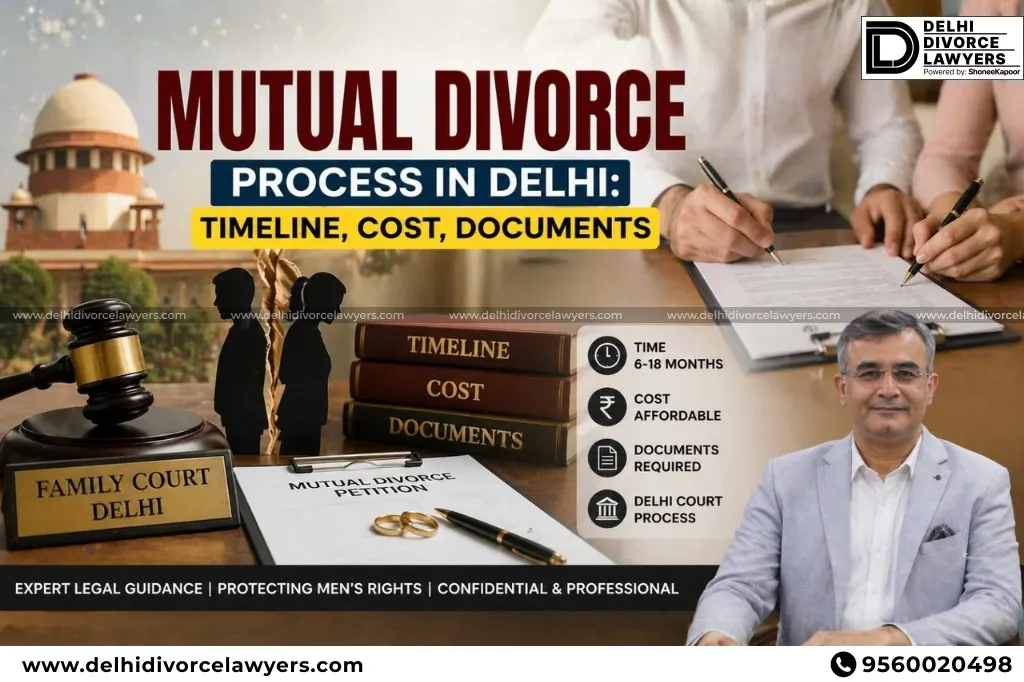
Complete 2026 Guide to Mutual Consent Divorce in Delhi with Cost and Documents
NEW DELHI: Marriage breakdown is emotionally draining, but endless litigation makes it worse. Where both spouses agree that the relationship has irretrievably failed, mutual divorce in Delhi is usually the fastest, most practical, and least destructive legal route.
Instead of years of allegations, evidence, and courtroom hostility, mutual consent divorce allows couples to settle issues like alimony, child custody, residence, and pending disputes with dignity.
If handled correctly, a mutual divorce petition in Delhi can be completed efficiently through the Family Courts. If handled poorly, it can collapse midway and become contested litigation.
This guide explains the timeline, cost, documents, legal provisions, case laws, and practical strategy for mutual divorce in Delhi.
What is Mutual Consent Divorce Under Indian Law?
Mutual divorce means both husband and wife jointly approach the court seeking dissolution of marriage because they can no longer live together and have mutually agreed to separate.
Legal Provision: Section 13B, Hindu Marriage Act, 1955
For Hindus, Sikhs, Jains, and Buddhists, mutual divorce is governed by:
Section 13B of the Hindu Marriage Act, 1955
It provides that parties may jointly file for divorce if:
- They have been living separately for at least one year
- They have not been able to live together
- They mutually agree marriage should be dissolved
Other Applicable Laws
- Section 28, Special Marriage Act, 1954 – Civil marriages/interfaith marriages
- Indian Divorce Act (for Christians)
- Personal law specific statutes where applicable
Who Can File Mutual Divorce in Delhi?
You may file a mutual divorce petition in Delhi if:
Basic Eligibility Conditions
- Valid Marriage Exists: There must be a legally recognized marriage.
- Separation for At Least One Year: Living separately does not always mean separate houses. It means spouses are not living as husband and wife.
- No Possibility of Reconciliation: Marriage has effectively broken down.
- Free Consent of Both Parties: No coercion, fraud, or pressure.
Where to File Mutual Divorce in Delhi?
The petition is generally filed before the appropriate Family Court in Delhi having jurisdiction.
Jurisdiction may arise where:
- Marriage was solemnized
- Parties last resided together
- Wife currently resides (in many situations)
- Respondent resides
Delhi has multiple Family Court districts, so filing in the correct court matters strategically.
Mutual Divorce Process in Delhi – Step by Step
Step 1: Settlement Negotiation
Before filing, parties should finalize all disputes in writing.
Key Settlement Issues
- Permanent alimony / one-time settlement
- Monthly maintenance (if any)
- Child custody and visitation
- School fees / future expenses
- Return of jewellery / articles / stridhan
- Property division
- Withdrawal/quashing of criminal or civil cases, if lawful and applicable
Poorly drafted settlements create future litigation.
Step 2: Drafting of Joint Petition
The petition includes:
- Marriage details
- Dates of separation
- Reasons for breakdown
- Settlement terms
- Statement that consent is voluntary
Affidavits are usually filed along with supporting documents.
Step 3: Filing Before Family Court Delhi
Once filed:
- Case number is generated
- Matter is listed before the judge
- First motion date is assigned
Step 4: First Motion Statements
Both parties appear in person, and statements are recorded.
Court verifies:
- Identity of parties
- Voluntary consent
- Terms of settlement
- Possibility of reconciliation
If satisfied, the first motion is allowed.
Step 5: Cooling-Off Period
Under Section 13B(2) HMA, traditionally there is a waiting period between first and second motion.
Important Supreme Court Judgment
Amardeep Singh v. Harveen Kaur (2017) 8 SCC 746
The Supreme Court held that the six-month cooling-off period is directory, not mandatory.
Meaning: In suitable cases, the court may waive it.
When Waiver May Be Granted
- Parties already separated long enough
- Settlement complete
- No chance of reunion
- Further waiting only prolongs suffering
This is crucial for fast mutual divorce in Delhi.
Step 6: Second Motion Hearing
Both parties reappear and confirm:
- Consent continues
- Settlement complied with or in progress
- They still seek divorce
Step 7: Decree of Divorce
If satisfied, the Family Court grants divorce by decree.
Marriage legally ends from the date of decree.
Obtain a certified copy for records, remarriage, visa, bank, and documentation purposes.
Timeline for Mutual Divorce in Delhi
Standard Timeline
Usually 6 to 8 months depending on listing dates and court workload.
Fast Cases with Waiver
Can conclude in 1 to 3 months in suitable matters.
Delay Factors
- One spouse absent on hearing date
- Incomplete payment terms
- Defective documents
- Jurisdiction objections
- Pending disputes not settled properly
Cost of Mutual Divorce in Delhi
Costs vary by complexity, urgency, assets involved, and lawyer experience.
Typical Range
Basic Mutual Divorce Matters
₹25,000 to ₹60,000
Mid-Level Negotiated Matters
₹60,000 to ₹1,50,000
Complex / High Net Worth / Multiple Cases
₹1,50,000+ to several lakhs
Additional Expenses
- Affidavit / notary
- Certified copies
- Documentation charges
- Settlement drafting
- Quashing petitions if criminal matters exist separately
Lowest fee often becomes highest total cost if drafting is defective.
Documents Required for Mutual Divorce in Delhi
Identity Proof
- Aadhaar
- PAN
- Passport
- Voter ID
Marriage Proof
- Marriage certificate
- Wedding photographs
- Invitation card (if certificate unavailable, depending on facts)
Address Proof
Current residence proof of both parties.
Income Documents
- Salary slips
- ITR
- Bank statements (where alimony disputed)
Children Documents
- Birth certificates
- School records (if custody involved)
Settlement Documents
- Signed memorandum of settlement
- Payment proof
- Asset transfer papers if relevant
Can One Party Withdraw Consent Later?
Yes. Consent must continue till final decree.
Landmark Case
Sureshta Devi v. Om Prakash (1991) 2 SCC 25: The Supreme Court held either party may withdraw consent before decree.
Later Reaffirmed
Hitesh Bhatnagar v. Deepa Bhatnagar (2011) 5 SCC 234: Mutual consent must subsist till final disposal.
Practical Reality
Never assume filing guarantees divorce. Strategic settlement sequencing matters.
Alimony in Mutual Divorce
Alimony is not automatic. It depends on:
- Income levels
- Earning capacity
- Lifestyle during marriage
- Duration of marriage
- Dependents
- Settlement willingness
Relevant Provision
Section 25, Hindu Marriage Act – Permanent alimony.
Common Structures
- One-time lump sum
- Staggered payments linked to motions
- No-claim mutual waiver (where appropriate)
Child Custody in Mutual Divorce
Child matters are decided on welfare principle, not parental ego.
Relevant Provision
Section 26, Hindu Marriage Act
Possible arrangements:
- Sole custody with visitation
- Joint parenting schedules
- Shared holidays
- Expense allocation
Vague clauses here create future contempt and execution disputes.
Common Mistakes People Make
- No Written Settlement Clarity: Future fights guaranteed.
- Paying Full Amount Before Safeguards: Risky.
- Ignoring Tax / Property Transfer Impact: Expensive later.
- Poor Child Custody Clauses: Leads to recurring litigation.
- Hiring Only by Cheapest Fee: Often false economy.
CONCLUSION
When a marriage has genuinely broken down beyond repair, mutual divorce is often the most practical, dignified, and legally efficient solution. It allows both parties to exit the relationship with clarity instead of spending years in hostile litigation.
However, mutual divorce should never be treated as a mere formality. It involves binding decisions on alimony, child custody, property rights, future claims, and legal closure—all of which can impact both parties for years to come.
A carefully planned and professionally drafted mutual divorce can save time, money, emotional stress, and future disputes. On the other hand, rushed settlements, vague terms, or poor legal advice often lead to fresh litigation after divorce.
The objective is not merely to obtain a decree—it is to secure a clean, enforceable, and conflict-free exit. That is where proper legal strategy makes all the difference.
FAQs
- How long does mutual divorce take in Delhi?
Typically 6–8 months. It may conclude faster if the cooling-off period is waived by the court. - Can mutual divorce be granted in one day?
However, timelines can be expedited in appropriate cases at the court’s discretion. - Is a lawyer necessary for mutual divorce?
Not mandatory, but professional assistance is advisable to ensure legally sound settlement terms. - Can NRI couples file for mutual divorce in Delhi?
Yes, subject to jurisdiction and case-specific facts. - Can maintenance be waived in mutual divorce?
Yes, if both parties voluntarily agree and the court is satisfied with the settlement.